
 By
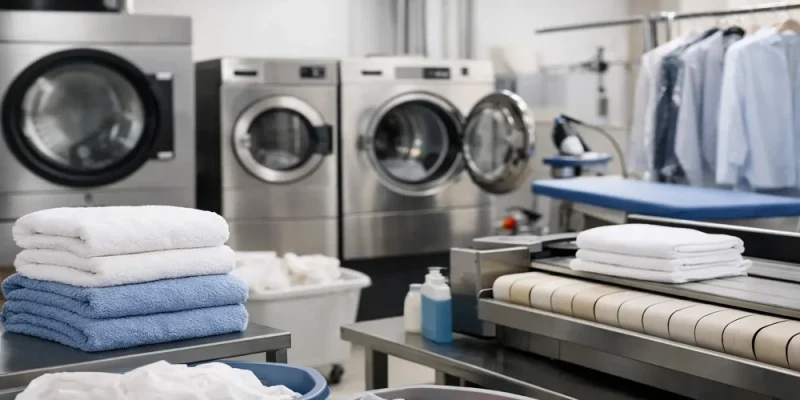
Three hours. That’s what a typical small business owner in West Texas loses every week to towels, uniforms, and shop rags, and that’s a conservative estimate once you count the folding.
I’ve watched plenty of owners treat laundry as a chore they’ll get to later. It never gets easier. The pile grows, the good towels disappear into someone’s truck, and eventually a customer walks in while you’re stuffing a washer at the back of the shop. If that sounds familiar, a commercial laundry service in Odessa can take the whole task off your plate, and the math usually works better than running it yourself.
Below is the honest version of how to decide: what to hand off, what to keep in house, and how to spot a provider that won’t wreck your linens or your budget.
What’s actually eating your week
Laundry at a small business isn’t one task. It’s five. You collect, you sort, you wash, you dry, and then you fold or hang, and each step interrupts whatever else you were doing. A mechanic with grease on his FR clothing can’t drop everything to flip a load. A salon owner can’t leave a client under the dryer to go move towels.
Here’s the part most owners underestimate: the hidden cost isn’t the washing. It’s the fragments of attention. Studies on workplace focus are clear that interruption carries a real price, and the Centers for Disease Control and Prevention has long documented how fragmented attention on the job raises the risk of mistakes. Translation for your towel pile: the guy running the washer is not running the counter.
So the first question isn’t “can I afford pickup and delivery?” It’s “what is one hour of my day actually worth?” Answer that, and the decision usually makes itself.
Sort your laundry into three buckets
Before you call anyone, walk through your operation and tag every textile. Three categories cover almost everything.
- Volume linens: towels, sheets, aprons, tablecloths. High count, low complexity, easy to hand off.
- Workwear and uniforms: shirts, pants, coveralls, flame-resistant gear. These need consistent care and, in some cases, specific handling standards.
- Personal or specialty items: anything with a stain you care about, delicate fabrics, or garments with sentimental or brand value. This is the bucket I’d keep close to home.
Most businesses should hand off the first two buckets entirely and keep a small watchful eye on the third. That split keeps quality where it matters and stops you from paying premium handling on a rag you were going to throw out next month.
The FR question nobody asks early enough
If any of your crew wears flame-resistant clothing, this is the section that matters most. FR garments aren’t ordinary fabric. Washing them wrong, with the wrong detergent or the wrong care routine, can degrade the protective properties you paid for, and a lot of owners don’t find that out until an inspection or an incident.
Ask any provider directly whether they handle FR to the relevant standards. If they hedge, move on. This is the one category where I’d take a slightly higher price for proven process every single time, because the exposure isn’t worth saving a few dollars a load.
According to the National Institute of Standards and Technology, keeping protective equipment performing as designed is a documentation and process discipline, not a guess. Ask for the process in writing. How do they separate FR from everything else? What detergent do they use? Get an answer you can repeat back to an inspector.
A practical walk-through for your first month
Week one: measure before you commit
Count everything. How many pounds of towels per week? How many uniforms? Write the numbers down for seven days straight, because your gut estimate will be wrong, usually high. Then call two or three providers and ask for a quote against those real numbers.
Week two: read the fine print on pricing and contracts
Watch for the two traps. First, per-piece pricing that looks cheap until you see minimums. Second, multi-year contracts with auto-renewal buried in the terms. A short, plain invoice you can read in thirty seconds beats a slick proposal every time. Ask outright: what happens if I want to stop?
Week three: run a test batch
Send your toughest items first, not your easiest. Stained kitchen towels, a grease-marked work shirt, one FR garment. Judge the results honestly and check the turnaround against the promise. If they say 24 to 48 hours, time it.
Week four: build the routine
Once you’ve chosen, set a pickup day and a drop-off spot that doesn’t require anyone to think. Label bins by category. Put one person in charge of the handoff, and make sure a backup knows the drill. The whole point is that nobody has to remember laundry exists.
What separates a good provider from a frustrating one
Price is the easiest thing to compare and the least useful. Here’s what I’d actually weigh.
| What to check | Why it matters |
|---|---|
| Local ownership | You can reach a decision maker, not a call center script |
| Contract terms | Short or none means they earn your business every month |
| Stain and spot handling | Separates professional service from a coin machine |
| Turnaround reliability | A late delivery is a scheduling problem you didn’t plan for |
I’d rather work with an owner who answers the phone than a national brand with a slick portal. When something goes wrong, and occasionally it will, you want a human who cares about the next invoice, not a ticket number.
The Small Business Administration puts it plainly in its guidance on choosing vendors: ask for references and check them. Call a business that’s been using the service for a year. Ask what broke and how fast it got fixed. That one call tells you more than any brochure.
The control question
Owners hesitate to hand off laundry because they want to stay in control of quality. Fair. So build control into the arrangement instead of holding onto the labor. Request that special instructions travel with each order, whether that’s “no bleach on the dark aprons” or “hang dry the uniforms.” A good provider follows those notes without being reminded.
Here’s my stance, and it’s a firm one: if a provider can’t follow written instructions on a test batch, they aren’t going to follow them at month six when you’re not watching. Test the follow-through early. You’ll know within two weeks whether you can stop thinking about it.
One more thing worth naming. The real win isn’t the hours you save, though those add up fast. It’s that the towel pile stops being a source of friction between you and your team. Nobody argues about whose turn it is when a bin gets picked up on Tuesday morning and comes back Wednesday folded.
Where to start this week
Pick a day. Count your linens for seven days. Call two providers and ask three questions: how do you handle FR, what are your contract terms, and what’s your turnaround. Run one test batch before you commit to anything.
That’s it. You don’t need a committee, a spreadsheet, or a six-month evaluation. You need one honest measurement and one good local partner you can call by name. So here’s the question worth sitting with: if you got those three hours back every week, what would you actually do with them?










Comments